35 Window Treatment Ideas for Every Room in 2026
The best window treatment ideas for 2026 combine layered fabrics, smart motorized shades, and warm, earthy colors that suit any room. Window treatments control light, add privacy, and finish a room’s design in one move. This guide lists 35 window treatment ideas for living rooms, bedrooms, kitchens, dining rooms, and large windows. It also covers the 2026 trends, window treatment materials, the main types of window coverings, common mistakes to avoid, and how to choose the right option for your budget and room. Use these window treatment suggestions as a starting point, then adjust for your room’s light, privacy, and style needs.
What Is a Window Treatment?
A window treatment is any covering fitted to a window for light control, privacy, insulation, or decoration. The category includes curtains, drapes, blinds, shades, shutters, valances, and cornices. Homeowners fit window treatments for four reasons: light control, privacy, insulation, and decoration.
A window treatment differs from a window covering in scope. Window covering usually means the functional layer alone, such as a blind or a shade. Window treatment includes decorative layers, such as curtains, cornices, and trim, on top of that functional layer. In the UK, window treatments are often called window dressing, and the two terms mean the same thing.
Window Treatment Trends for 2026
Layered window treatments, smart shades, and warmer color palettes lead the window treatment trends for 2026. Six trends shape most new window designs this year, and most rooms combine two or three of them rather than following just one:
- Layered treatments pair sheers, shades, and drapery on one window for texture and full light control.
- Smart shades connect to a phone app or voice assistant and open or close on a set schedule.
- Earthy colors, such as moss green, terracotta, sand, and stony grey, replace the cool grey tones of the past decade.
- Natural textures, such as linen, bamboo, and woven grass, add warmth to minimalist rooms.
- Traditional details, such as tassels, fringe, and upholstered cornices, return alongside cleaner, tailored shapes.
- Energy-efficient cellular and solar shades cut heat loss in winter and block most UV rays in summer.
Modern window treatments favor slim profiles, matte hardware, and solid colors over heavy pattern. Motorized roller shades and slim Venetian blinds represent the cleanest modern design window treatments available right now. For a deeper look at how color and texture trends move through a whole home, see our guide to 16 types of interior design styles.
Window Treatment Materials Compared
Fabric and material choice affects light control, durability, and price more than any other decision. Compare the four most common materials before you pick a style:
- Linen: breathable, textured, and light-filtering; wrinkles easily and needs a lining for full blackout.
- Velvet: heavy, insulating, and blackout-capable; traps dust and needs occasional professional cleaning.
- Cotton and cotton-blend: affordable, easy to wash, and available in the widest range of patterns.
- Faux wood and bamboo: moisture-resistant and durable; heavier than fabric and needs sturdy brackets.
Pair a heavier material, such as velvet or faux wood, with a room that needs insulation or noise control. Choose linen or cotton for rooms where airflow and a lighter look matter more than blackout performance. Check the fabric’s opacity rating if the product listing includes one; sheer fabrics let through 40% or more of outside light, light-filtering fabrics let through 10% to 40%, and blackout fabrics block 95% or more.
Types of Window Coverings (Window Blinds Ideas & More)
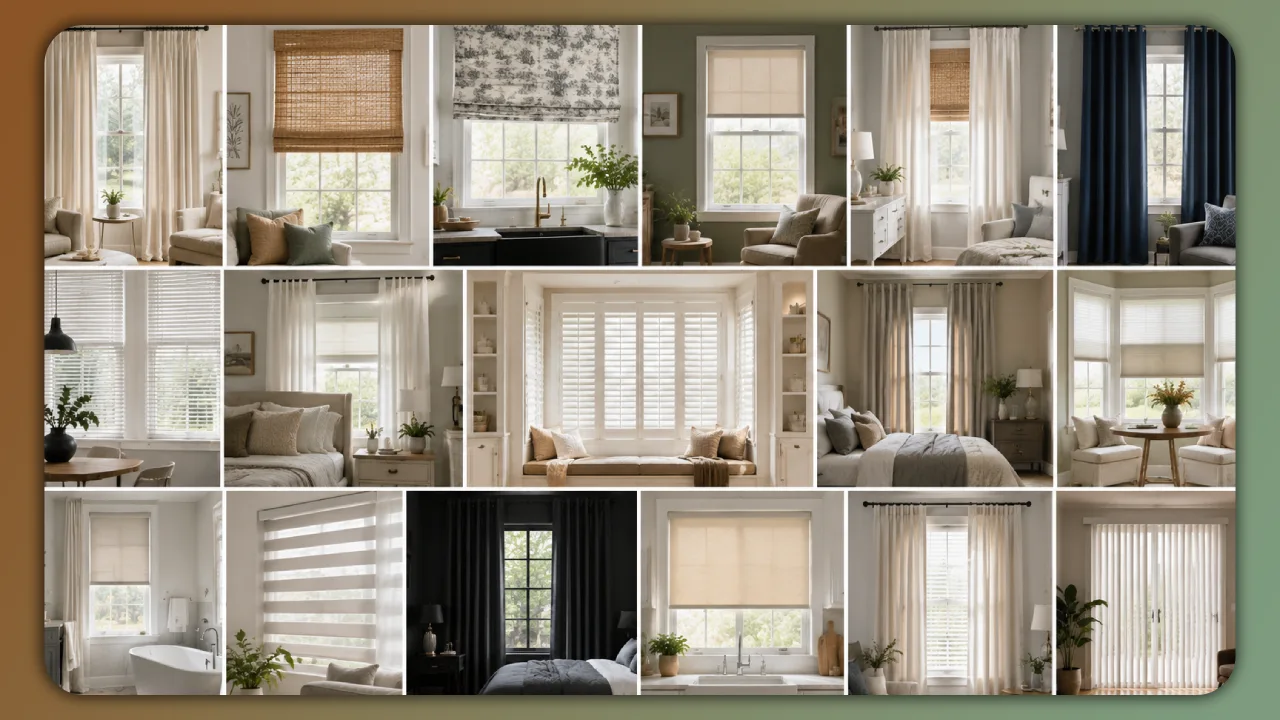
Window coverings fall into four groups: soft fabric treatments, hard coverings, shades, and decorative toppers. These window covering ideas span both hard and soft materials, so mix them to match your room’s function.
- Soft fabric treatments, such as curtains, drapes, and sheers, soften a room and absorb sound.
- Hard coverings, such as roller blinds, Venetian blinds, vertical blinds, and plantation shutters, give precise light control and suit high-moisture rooms.
- Shades, such as Roman shades, cellular shades, and roller shades, sit flush against the window and layer well under curtains.
- Decorative toppers, such as valances, cornices, and pelmets, hide curtain hardware and finish the top of a window.
Layered combinations stack two or more of the above groups on one window, such as a roller shade under a curtain panel, and give you both hard-covering light control and soft-fabric styling in one setup.
Roman shades fold into soft horizontal pleats when raised, and they suit both formal and casual rooms. Cellular shades trap air inside honeycomb-shaped pockets, and this design improves insulation compared with a single flat shade. Plantation shutters use wide louvers, typically 2.5 to 4.5 inches (6 to 11 cm), and they outlast fabric treatments in humid rooms, such as bathrooms and kitchens. Each of these window covering design ideas suits a different light and privacy need.
Living Room Window Treatment Ideas
Living room window treatment ideas need to balance style with everyday light control. These living room window covering ideas mix hard and soft materials for the best of both. Try these eight window drapes ideas and shade pairings:
- Floor-length linen drapes in a neutral tone anchor a large living room window.
- Layered sheers under blackout drapery control light without losing an airy feel.
- A woven Roman shade under bold patterned curtains combines two textures in one window.
- Motorized roller shades in matte black frame a modern window without visible hardware.
- An upholstered cornice in the sofa fabric ties the window into the room’s color scheme.
- Wide-plank plantation shutters suit a coastal or transitional-style living room.
- Curtain panels hung close to the ceiling, rather than at the window frame, make an 8-foot window look taller.
- Vertical blinds updated in a linen-look fabric fit sliding glass doors and patio windows.
For more ways to build a room around one focal point, see our guide to 35 home decor ideas for every room.
Bedroom Window Treatments
Bedroom window treatments prioritize privacy and light control over daytime style. A bedroom window sits closer to eye level from the bed than in any other room, so glare and early light matter more here than the pattern on the fabric. Five ideas work well in most bedrooms:
- Blackout curtains layered over sheers block morning light while keeping a soft daytime look.
- Cellular shades add an insulating air pocket that reduces heat loss through the window in winter.
- Bamboo or woven wood shades bring texture to a bedroom without heavy drapery.
- A single wide curtain panel over a small window keeps a compact bedroom feeling open.
- Cafe curtains that cover only the bottom half of a window protect privacy while the top stays clear for light.
Kitchen Window Treatments
Kitchen window treatments need to survive splashes, steam, and grease. Four ideas fit a working kitchen:
- A short roller shade above the sink clears the faucet and wipes clean.
- A ruffled valance adds a farmhouse-style finish without blocking counter workspace.
- Roman shades in a wipeable, treated fabric suit a window near the stove.
- Cafe curtains on a kitchen door keep the lower half private while the top stays clear.
Dining Room Window Treatment Ideas
Dining room window treatment ideas usually lean formal, since the room hosts guests more than daily traffic. A dining room window also sits behind a table for years without a style change, so pick a treatment that suits both daytime meals and evening entertaining. Four options set the right tone:
- Full-length drapery in a rich color, such as emerald or burgundy, sets a formal mood for dinner parties.
- Sheer panels alone let natural light fill a bright breakfast nook.
- A pair of tailored Roman shades keeps a small dining window neat.
- Layered drapery with a contrast trim frames a bay window behind the dining table.
Window Treatment Ideas for Large Windows
Large windows need hardware and fabric rated for the extra width and weight. Four ideas handle oversized glass:
- Motorized shades cover hard-to-reach or oversized windows without a step ladder.
- Floor-to-ceiling curtain panels on an extra-wide track cover a full wall of windows or a sliding door.
- Solar shades cut glare on south-facing walls of glass while keeping the outside view visible.
- Panel track blinds slide along a rail and work well for windows wider than 6 feet (1.8 m).
Unique Window Covering Ideas for Bay, Arched & Skylight Windows
Bay, arched, and skylight windows need different hardware than a standard rectangular window.
- Bay windows: fit each pane with its own shade, or install a curved curtain track that follows the wall for one continuous drape.
- Arched windows: leave the curved top bare and dress only the rectangular section below it, or fill the arch with a fixed, fan-shaped fabric panel.
- Skylights: use a top-down/bottom-up cellular shade, which opens from either the top or the bottom edge, to control glare from any angle.
- Corner windows: use two independent shades on a shared bracket, or a continuous curtain track that wraps the corner, so each window opens independently.
Match hardware to the window shape before you choose fabric. A curved track, a fan-shaped panel, or a wrap-around bracket only comes in a handful of sizes, so measure the window first and pick fabric that fits an available hardware option.
Common Window Treatment Mistakes to Avoid
Five mistakes cause most window treatment disappointments. Avoid these before you order fabric or hardware:
- Hanging the rod at the window frame instead of higher on the wall, which shortens the window visually.
- Buying curtain panels too narrow for the window, which leaves fabric looking skimpy when closed.
- Choosing blackout fabric for a room that needs daytime light, such as a home office or kitchen.
- Skipping a lining on sheer or linen curtains in a bedroom that faces the morning sun.
- Matching every window treatment in the house to one style instead of adapting to each room’s function.
How to Choose the Right Window Treatment Design Ideas
Choose a window treatment based on three factors: light control, privacy, and budget.
- Light control: sheers filter light, blackout fabric blocks it, and shades fall somewhere in between, depending on fabric weight.
- Privacy: layer a sheer with a blackout curtain or shade if you need daytime light and nighttime privacy in the same window.
- Budget: premade curtains cost less than custom drapery, while blinds and shades usually fall in between.
Table by Window Treatment Type
| Window Treatment Type | Typical Cost Per Window | Best For |
| Premade curtains | $30 – $200 | Renters, quick refresh, tight budgets |
| Blinds or roller shades | $50 – $300 | Kitchens, bathrooms, everyday light control |
| Cellular or solar shades | $100 – $500 | Energy efficiency, large or sun-facing windows |
| Custom drapery | $300 – $2,500+ | Formal rooms, oversized or unusually shaped windows |
Measure the window width and multiply by 1.5 to 2 for a full, gathered curtain look. Hang the curtain rod 4 to 6 inches (10 to 15 cm) above the window frame, and extend it 3 to 6 inches (8 to 15 cm) past each side, to make the window look wider. Choose floor-length curtains that either brush the floor or hover 0.5 to 1 inch (1 to 2.5 cm) above it for a tailored finish. Order 10% extra fabric for pattern matching if you buy a patterned material, since dye lots and repeat patterns vary between rolls.
Test your light control choice before you commit to a full room. Hang one panel or one shade on your most-used window for a week, and check how it performs at both sunrise and sunset before you order the rest of the room.
Match the window treatment to your room’s broader style. Our guide to 16 types of interior design styles breaks down how Scandinavian, coastal, industrial, and other design styles each call for a different window treatment approach. Browse the Home Decor Ideas and Room by Room categories for more pictures of window treatments and room-specific window decorating ideas.
FAQs
What is a window treatment?
A window treatment is any covering fitted to a window for light control, privacy, insulation, or decoration, including curtains, blinds, shades, and shutters.
What are the window treatment trends for 2026?
The 2026 window treatment trends favor layered fabrics, smart motorized shades, earthy colors, natural textures, and a revival of traditional details, such as tassels and upholstered cornices.
Can you mix curtains and blinds in the same room?
Yes. Curtains and blinds work well together. Hang blinds or shades close to the glass for light control, then add curtains on a rod in front for texture and softness. This pairing also lets you swap the curtains for a new season or color scheme without replacing the functional layer underneath.
How much do window treatments cost?
Premade curtains cost $30 to $200 per panel, and custom drapery costs $300 to $2,500 or more per window, depending on fabric, lining, and hardware. Blinds and shades typically fall between these two ranges.
What is the best window treatment for large windows?
Motorized shades or panel track blinds work best for large windows because they cover wide spans without heavy manual pulling and keep fabric weight evenly distributed. Reinforced brackets and a wider hardware gauge also prevent sagging on windows over 6 feet (1.8 m) wide.
Do sheer curtains work in bedrooms?
Yes, if you layer them with blackout drapery or a shade behind them. Sheers alone do not block enough light for most sleepers.
How long should curtains be for a standard window?
Standard curtains hang 84 inches (213 cm) long for an 8-foot ceiling. Floor-length panels should fall between 0.5 inches above the floor and a slight puddle, depending on the formality you want. Sill-length curtains, which stop just below the window frame, suit kitchens and small rooms where floor-length fabric would get in the way.
Final Thoughts
These 35 window treatment ideas cover every room, budget, and window shape. Start with the room you use most, layer for both privacy and light control, and pick colors and textures that match your home’s overall style. Order one sample or one panel before you commit to a whole house, and revisit the 2026 trends above only after you’ve settled the basics of light control, privacy, and budget. A window treatment that solves your daily light and privacy needs will outlast any single-year trend.