Contemporary Interior Design: The Complete 2026 Guide
Contemporary interior design means decorating in the style of right now, not a fixed historical period. It blends clean lines, a neutral color palette, and mixed materials into a look that updates as trends shift. Modern design remains rooted in the 1930s through the 1960s. This style keeps changing every few years, which is exactly why it stays popular in 2026.
This guide covers the 6 core principles of the style, a room-by-room breakdown, current color and material choices, and the mistakes that make a contemporary space feel cold instead of current. Use it to plan a living room, bedroom, kitchen, or full home refresh that works across UK, US, and Canadian homes.
What Is Contemporary Interior Design?
Contemporary interior design is the style of the current moment, built on 3 things: clean lines, an uncluttered layout, and a neutral base with bold accents. It has no fixed era, which sets it apart from modern design, a specific movement tied to the 1930s to 1960s. A contemporary room decorated in 2015 looks different from one styled in 2026 because style absorbs new colors, materials, and technologies as they emerge.
Designers build contemporary rooms on a neutral foundation of white, grey, taupe, and black. They layer in texture through mixed materials such as glass, wood, metal, and fabric. Furniture often takes a sculptural form, so a chair or coffee table works as functional art rather than a plain utility piece.
The style suits 3 types of homeowners best: first-time buyers who want a flexible look that can grow with new trends, renters who need furniture that resells well, and anyone who dislikes the strict rules of traditional or period styles. Because the palette stays neutral, a contemporary room also adapts easily to a change in artwork, cushions, or a rug without a full redecoration.
Where Contemporary Design Comes From
Contemporary design grew out of modernism but dropped its strict rules. Modernism, which took hold in the 1930s, insisted on function over decoration and a narrow material list of wood, chrome, and leather. Contemporary design kept the focus on function but opened the door to curves, color, and new technology, which is why it never settled into 1 fixed look the way modernism did.
Interior magazines often trace the shift to the late 1970s and 1980s, when designers began mixing minimalism with bold art and unconventional shapes. Each decade since has added its own layer: the 1990s brought glass and steel, the 2000s added smart lighting, and the 2020s introduced sustainable materials and curved, organic furniture. This style in 2026 carries all of these influences at once, filtered through a warmer, more livable lens than the stark minimalism of a decade ago.
Iconic Examples of Contemporary Architecture and Interiors
Studying real buildings helps translate the style from theory into a room. The Eden Project in Cornwall pairs biome-like glass domes with a planting scheme that blurs the line between the built structure and nature, a core contemporary idea. The Heydar Aliyev Center in Baku, designed by Zaha Hadid, pushes fluid, curved architecture further than almost any other public building, and its lobby shows how a single sculptural form can define an entire interior.
Closer to home decor, the refurbished interiors inside Casa Batllo in Barcelona show contemporary updates layered onto a historic shell, proof that the style works in renovation projects, not only new builds. The Shed in New York uses a shape-shifting structure to change function on demand, echoing how contemporary furniture and open floor plans let 1 room serve several purposes across a single day. Smaller-scale projects, like a Scandinavian hotel lobby built from raw concrete and warm wood, translate the same principles: clean lines, natural material contrast, and a neutral base, into spaces people actually live and work in.
Contemporary vs Modern Design: What Is the Difference?
No, contemporary design and modern design are not the same style. Modern design locks into the mid-20th century: teak wood, Eames-style chairs, and a strict earth-tone palette. Contemporary design borrows some of that restraint but adds curves, bold pattern, and smart technology, and it keeps evolving instead of staying fixed to one decade.
| Factor | Modern Design | Contemporary Design |
| Time period | Fixed: 1930s to 1960s | Fluid: reflects the present decade |
| Color palette | Earth tones, primary colors | White, grey, taupe, black, with bold accents |
| Furniture shape | Geometric, angular | Curved and sculptural |
| Materials | Wood, leather, chrome | Glass, metal, wood, velvet, stone |
| Flexibility | Stays true to one look | Adapts to new trends every few years |
6 Core Principles of This Style
Every contemporary room shares 6 traits, regardless of budget or country.
- Clean lines. Furniture and architecture favor straight or gently curved edges over ornate detail.
- Open floor plans. Kitchens, dining rooms, and living rooms flow into one space with minimal internal walls.
- Neutral color palette. White, grey, taupe, and black form the base, with 1 or 2 bold accent colors layered on top.
- Mixed materials. Glass, wood, metal, and fabric combine in a single room to add contrast and depth.
- Statement furniture. 1 sculptural chair, sofa, or light fixture becomes the visual anchor of the room.
- Sustainability. Many contemporary spaces use FSC-certified wood, recycled textiles, and energy-efficient lighting.
Contemporary Color Palettes and Materials
Contemporary interiors follow a 60-30-10 color rule: 60% neutral base (white, grey, or taupe), 30% secondary tone (a deeper grey, navy, or warm beige), and 10% bold accent (emerald, rust, or mustard). This ratio keeps a room calm while still allowing a striking rug, cushion, or artwork to stand out.
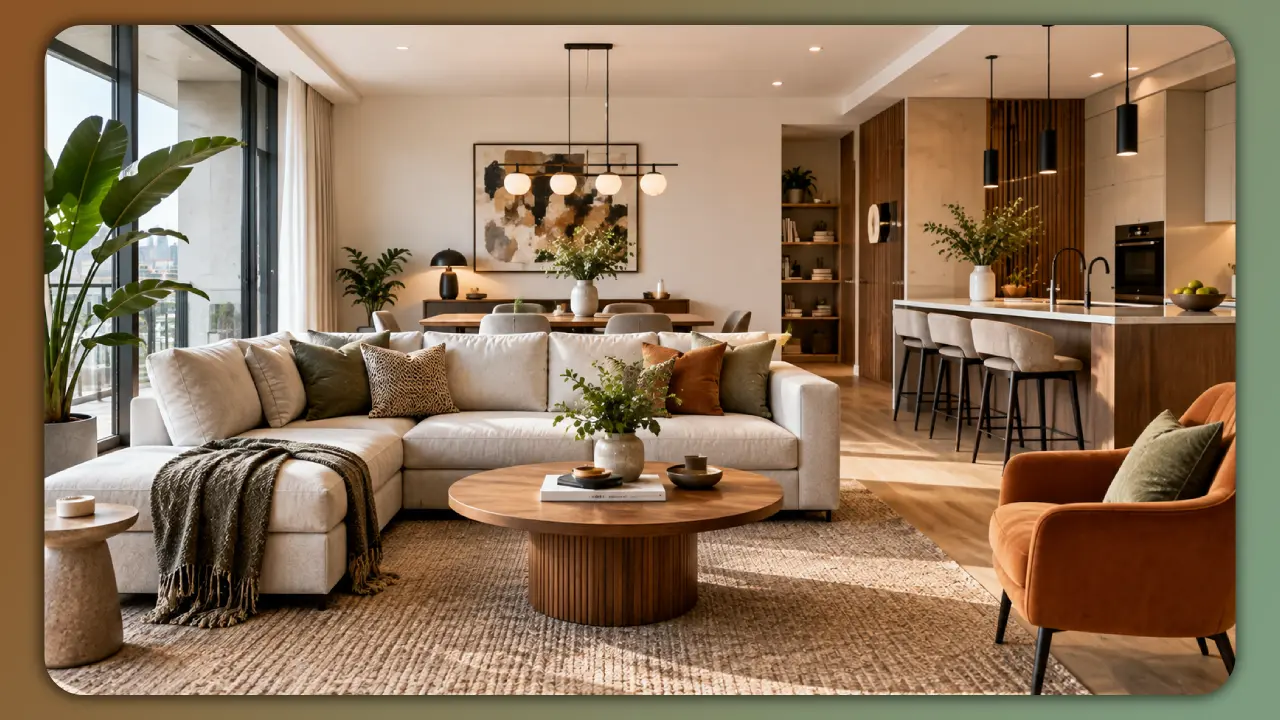
Materials matter as much as color. Glass coffee tables pair well with a velvet sofa. A honed stone counter softens next to wool cushions or a jute rug. Brushed brass or matte black metal hardware adds a sharp edge against pale wood floors. Combining at least 3 materials in one room, for example wood, metal, and textile, keeps a neutral palette from feeling flat.
Fabric choice shifts the mood of a contemporary room more than most homeowners expect. Bouclé and velvet add softness to a sofa or accent chair without introducing pattern. Linen and cotton keep window treatments and cushions breathable, which suits both a warm UK summer and a humid Canadian one. Leather, whether full-grain or a performance alternative, adds a harder edge to a reading chair or ottoman and wears well in a high-traffic living room.
How to Layer Lighting in a Contemporary Home
To layer lighting in a contemporary home, combine 3 types of lighting: ambient, task, and accent. Ambient lighting, such as a flush-mount ceiling fixture or track lighting, evenly illuminates the whole room. Task lighting, like a floor lamp beside a reading chair or under-cabinet strips in a kitchen, supports specific activities. Accent lighting, including a picture light or a sculptural pendant, highlights art or architecture.
Dimmer switches on all 3 layers allow a single room to shift from bright and functional during the day to warm and atmospheric at night, a hallmark of a well-executed contemporary room.
Bulb temperature matters as much as fixture choice. A range of 2700K to 3000K gives off a warm white that suits living rooms and bedrooms, while kitchens and home offices often work better closer to 3500K for task clarity. Mixing warm and cool bulbs in the same room creates a visual clash, so keep the temperature consistent across all 3 lighting layers in a single space.
Contemporary Design by Room
The style changes slightly by room, since each space has different lighting, traffic, and storage needs. A living room needs durable, family-friendly fabrics, a bedroom needs softer, warmer light, and a kitchen needs surfaces that survive daily wear. The 6 core principles above stay constant, but the ratio between them shifts from one room to the next.
Contemporary Living Room Ideas
Anchor the room with 1 statement sofa in a neutral tone, then add a curved accent chair for contrast. Use a large geometric or Berber-style rug to define the seating area within an open floor plan. Keep window treatments minimal; sheer panels or slim blinds work better than heavy drapes, so natural light stays the focal point. A gallery wall of 3 to 5 framed prints, hung close together, adds personality without breaking the room’s clean, uncluttered feel.
For 50 more layout and styling ideas, see our guide to living room ideas for 2026.
Contemporary Bedroom Ideas
Choose a low-profile upholstered bed in a neutral fabric, then add 2 floating nightstands to keep the floor visually open. Layer a wool throw or textured cushion in 1 accent color for warmth. Oversized pendant lights on either side of the bed replace bulky table lamps and free up nightstand space. Blackout curtains in a plain, textural weave keep the room dark for sleep without adding the pattern a traditional style would use.
Contemporary Kitchen Design
Pair matte or gloss handleless cabinets with a stone or quartz countertop for a seamless look. Add warmth with a wood island top or open wood shelving, since an all-hard-surface kitchen can feel sterile. Track or pendant lighting over the island supports both cooking tasks and evening entertaining.
Contemporary Bathroom Ideas
Use large-format porcelain tile in a neutral tone to minimize grout lines and visual clutter. A floating vanity with no visible hardware keeps the floor line clean, which makes a small bathroom feel larger. Add 1 organic touch, such as a stone soap dish or a small plant, to soften the hard surfaces.
Contemporary Home Office Ideas
Select a streamlined desk with built-in cable management, then add an ergonomic chair in leather or performance fabric. Open shelving in a mix of wood and black metal keeps storage visible but tidy. For more room-specific decor pairings across the whole house, browse our 35 home decor ideas for every room.
5 Contemporary Design Trends for 2026
Contemporary design in 2026 leans toward warmer, more sustainable aesthetics than the stark, all-white spaces of the early 2020s.
- Curved furniture. Rounded sofas, arched mirrors, and organic-shaped coffee tables replace strictly rectangular pieces.
- Warm minimalism. Taupe, terracotta, and warm greige replace stark white as the dominant neutral.
- Japandi crossover. Japanese restraint meets Scandinavian warmth through low furniture and natural wood tones.
- Smart home integration. Hidden charging stations, app-controlled lighting, and recessed speakers blend into the design instead of standing out.
- Sustainable materials. FSC-certified wood, recycled glass tile, and low-VOC paint appear in a growing share of new builds and renovations.
5 Contemporary Design Mistakes to Avoid
These 5 mistakes turn a contemporary space cold or dated instead of current.
- Skipping texture. An all-smooth room of glass, tile, and metal reads sterile without a rug, throw, or woven basket to soften it.
- Overcrowding the room. Contemporary design relies on negative space, so every extra side table or accessory should earn its place.
- Using only 1 lighting source. A single ceiling fixture leaves a room flat; 3 layers of lighting create depth.
- Mismatched furniture scale. An oversized sectional in a small room, or tiny accent chairs in a large one, breaks the room’s proportion.
- Ignoring the local climate and light. A palette built for a bright US Sunbelt home can feel flat under grey UK or Canadian daylight, so adjust warmth and lighting wattage accordingly.
How to Achieve Contemporary Design on a Budget
To achieve a contemporary design on a budget, focus on 3 changes rather than a full renovation. First, repaint walls in a neutral tone such as warm grey or taupe, which resets the whole room for the cost of paint alone. Second, add 1 statement piece, such as a sculptural lamp, a curved accent chair, or an oversized mirror, to serve as the room’s focal point. Third, swap hardware and lighting fixtures for matte black or brushed brass options, since these small metal details update a room’s feel without replacing any furniture.
For a full breakdown of the different design languages this style borrows from, see our guide to types of interior design styles.
Secondhand and vintage marketplaces are worth checking before buying new. A vintage brass floor lamp or a solid-wood sideboard often costs less than a new equivalent and adds the kind of character mass-produced pieces lack. Reupholstering 1 existing sofa in a neutral bouclé or linen fabric can also cost far less than replacing it, while still delivering the clean-lined look this style calls for.
Frequently Asked Questions
What is contemporary interior design?
Contemporary interior design is the decorating style of the present decade. It uses clean lines, a neutral color palette, mixed materials, and 1 or 2 statement pieces, and it changes as trends shift instead of staying fixed to a single historical period.
Is contemporary design the same as modern design?
No, contemporary design and modern design are different styles. Modern design is fixed to the 1930s through the 1960s, while contemporary design reflects whatever is current right now and keeps evolving.
What colors work best in a contemporary home?
White, grey, taupe, and black work best as the base, following a 60-30-10 split between a neutral base, a secondary tone, and 1 bold accent color such as emerald, rust, or navy.
Can contemporary design work in a small space?
Yes, contemporary design works well in small spaces. Its uncluttered layout, light color palette, and focus on natural light make a small room feel larger than a heavily decorated traditional style would.
Is contemporary design expensive?
No, contemporary design does not require a large budget. A neutral repaint, 1 statement furniture piece, and updated lighting or hardware can achieve the look for a fraction of a full renovation cost.
What furniture style fits this look?
Furniture with clean lines, curved or sculptural silhouettes, and a neutral or mixed-material finish, such as a velvet sofa on a metal frame, fits this look best.
How do I mix contemporary design with other styles?
Mix contemporary design with other styles by keeping the neutral base and clean lines, then layering in 1 or 2 elements from another style, such as a Japandi wood table or a bohemian textile, to create a personal, blended look. This approach also protects the budget, since only a few pieces need to change when trends shift.
Final Thoughts
Contemporary interior design works because it never asks a home to freeze in one decade. Start with clean lines and a neutral base, layer in mixed materials and 3 lighting sources, then add 1 or 2 statement pieces per room. Explore Spacekeep’s Room by Room and Design & Decoration categories for more 2026-ready inspiration, or browse the full site for every guide mentioned above.