How to Set Up a Home Office in a Small Room (2026 Guide)
To set up a home office in a small room, place a compact desk against 1 wall. Add side lighting, mount shelves above the desk, and run 1 Ethernet cable for stable internet. Spacekeep shows how to set up a home office for £223 to £555 in 1 weekend. A footprint of 20 square feet (1.9 square metres) fits 1 desk, 1 chair, and 1 shelf unit.
Most guides target large rooms and readers in the US or Australia. The 9 steps below cover small rooms, UK prices in pounds (£), and the 6 April 2026 homeworking tax change. Each step shows how to set up a home office with imperial and metric measurements. Measurements in both units help you buy furniture that fits.
How to Set Up a Home Office Layout in a Small Room
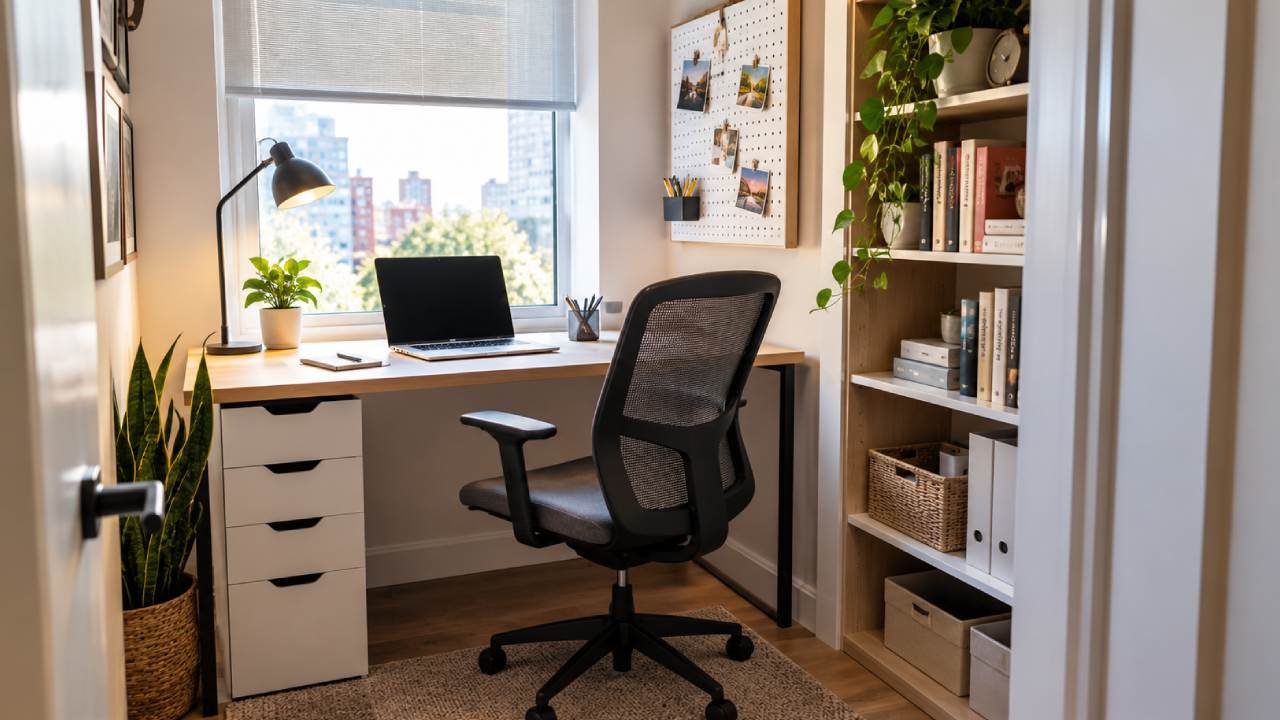
To set up a home office layout in a small room, tape a desk zone on the floor. The zone measures 4 by 5 feet (1.2 by 1.5 m). Place the desk against the longest wall. A wall position frees the centre of the room for walking and storage.
How to Measure a Small Room for a Home Office
To measure a small room for a home office, record the length, width, and ceiling height with a tape measure. Note 4 fixed features: the door swing, the window, the radiator, and the plug sockets.
Sketch the room on paper, then mark the desk zone with masking tape. A desk of 4 by 2 feet (1.2 by 0.6 m) leaves 3 feet (90 cm) for the chair. Sit inside the taped zone for 5 minutes to test the space.
How to Choose the Best Spot for Your Desk
To choose the best spot for your desk, rank 4 factors: natural light, plug sockets, noise, and door visibility. A spot beside a window beats a blank wall, because daylight reduces eye strain.
Small homes offer 5 workable spots: spare bedrooms, stair landings, under-stairs nooks, alcoves, and walk-in wardrobes (called cloffices). Avoid the kitchen and the sofa area, because foot traffic and television noise break focus.
How to Set Up a Home Office in an Alcove, Landing, or Wardrobe
To set up a home office in an alcove, landing, or wardrobe, measure the opening before you buy furniture:
- Alcoves, such as chimney recesses and window bays, suit a shelf desk 24 inches (60 cm) deep.
- Landings, such as stair landings and upstairs hallways, need 3 feet (90 cm) of clear walkway beside the desk.
- Wardrobes, such as walk-in and built-in models, suit a shelf desk after you remove the hanging rails.
Open the wardrobe doors while you work to keep air moving. Keep the stairs clear on a landing so the route stays safe.
How to Choose a Desk for a Small Home Office
To choose a desk for a small home office, match the desk shape to the available wall or corner. Pick a depth of at least 24 inches (60 cm) for monitor distance. A shallower desk pushes the screen too close to your eyes.
How to Pick 1 of 3 Space-Saving Desk Types
To pick 1 of 3 space-saving desk types, compare footprint, storage, and price:
- Corner desks, such as L-shaped and wraparound models, use dead corner space and add surface area.
- Wall-mounted desks, such as fold-down and floating models, clear the floor and fold flat after work.
- Sit-stand desks, such as electric and hand-crank models, switch between 2 positions and cost £150 to £400.
Choose a wall-mounted desk in a bedroom. And also choose a corner desk in a spare room. Choose a sit-stand desk if you want to alternate sitting and standing.
How to Set the Correct Desk Height
To set the correct desk height, adjust the surface to 29 inches (74 cm), the standard office height. Sit with elbows at 90 degrees and wrists flat. Raise the chair if your arms angle downward. Add a footrest if your feet leave the floor.
How to Choose an Ergonomic Chair for a Small Room
To choose an ergonomic chair for a small room, pick a compact mesh task chair. The chair needs adjustable height, lumbar support, and armrests. Mesh chairs, such as task and manager models, look lighter than bulky leather chairs.
Test 3 points before you buy. The seat height lets your feet rest flat. The backrest supports your lower back. The armrests slide under the desk.
Skip dining chairs, bar stools, and sofas for work. Dining chairs lack lumbar support and height adjustment. Research by the Royal Society for Public Health (RSPH) found 39% of new home workers reported musculoskeletal problems.
A task chair costs £50 to £200 in the UK. Set the seat so your knees sit level with your hips.
How to Sit at Your Desk With Correct Posture
To sit at your desk with correct posture, press your back against the backrest. Bend your knees to 90 degrees. Rest your feet flat on the floor. Keep the screen 20 inches (50 cm) from your eyes.
Stand and stretch for 2 minutes every 30 minutes. Keep daily items, such as your phone, notebook, and mug, within easy reach.
How to Light a Small Home Office Without Glare
To light a small home office without glare, place the desk side-on to the window. A window behind the monitor reflects on the screen. A window in front forces you to squint.
Add 1 desk lamp with adjustable brightness for task lighting. Choose a Light Emitting Diode (LED) bulb rated 4000 to 5000 Kelvin (K) for neutral white light. Office standards set 500 lux (lumens per square metre) for screen work.
Paint walls in pale shades, such as matt white and light grey. Pale walls reflect daylight deeper into the room. Follow the 20-20-20 rule: every 20 minutes, look at an object 20 feet (6 m) away for 20 seconds.
How to Store Supplies in a Small Home Office
To store supplies in a small home office, build upward and keep only daily items on the desk. Use 3 storage zones: the wall, the under-desk area, and the desk surface.
How to Use Wall Space for Storage
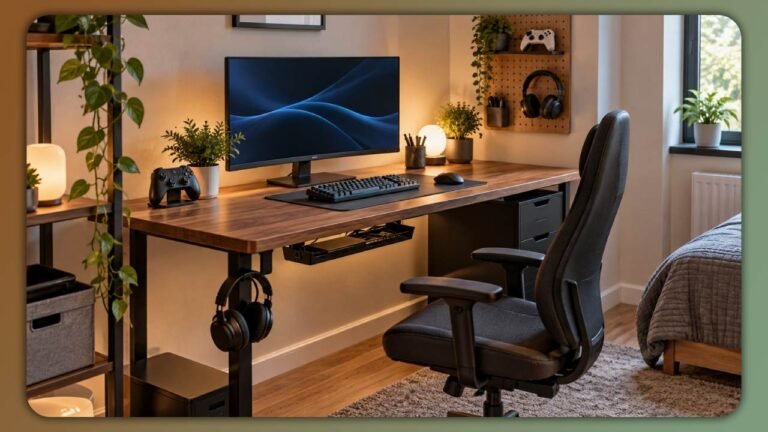
To use wall space for storage, mount floating shelves 16 inches (40 cm) above the desk surface. Add a pegboard for items such as headphones, scissors, and notepads. Shelves draw the eye upward, so the room feels taller. Shelves save the most floor space when you set up a home office in 20 square feet (1.9 square metres).
Read these small room storage ideas to plan shelf heights, baskets, and labels. Check your tenancy agreement before drilling. Use adhesive strips rated for the shelf weight in rented rooms.
How to Manage Cables and Power Strips
To manage cables and power strips, fix 1 power strip under the desk and bundle cords with hook-and-loop ties. Mount a cable tray under the desk edge for loose cords.
Choose wireless peripherals, such as a mouse, keyboard, and headset, to remove 3 cords. Use a surge-protected extension lead rated 13 amps (A). Never plug 1 extension lead into another.
Follow these cable management ideas to hide every cord behind the desk.
How to Set Up a Home Office Tech Kit in a Small Room
To set up a home office tech kit in a small room, start with 5 items: laptop, external monitor, keyboard, mouse, and headset. An external monitor and keyboard protect your neck and wrists.
Raise the screen so the top edge sits level with your eyes. Mount the monitor on a clamp-on arm to free desk space. Check the monitor has Video Electronics Standards Association (VESA) mounting holes. Standard spacing is 75 by 75 mm (3 by 3 inches) or 100 by 100 mm (4 by 4 inches).
Place the router within 25 feet (7.5 m) of the desk. Run a Category 6 (Cat 6) Ethernet cable for video calls. Add a mesh Wi-Fi (wireless internet) kit if 2 or more walls block the signal.
Light your face for video calls. Position the desk lamp behind the webcam, and keep the background clear of laundry and beds. Connect devices through 1 Universal Serial Bus Type-C (USB-C) hub to keep 1 cable on the desk.
How to Control Noise and Temperature in a Small Home Office
To control noise and temperature in a small home office, seal gaps and add soft surfaces. Keep the room between 18 and 21 degrees Celsius (64 and 70 degrees Fahrenheit).
Rugs, heavy curtains, and bookcases reduce echo. Soft surfaces matter most when you set up a home office beside a living room. Draught excluders, such as door strips and window foam, hold heat and reduce noise. Noise-cancelling headphones, such as over-ear and in-ear models, mute voices and televisions.
Fit a thermostatic radiator valve (TRV) to hold a steady temperature. Open a window for 5 minutes every 2 hours to refresh the air.
How to Make a Small Home Office Feel Larger
To make a small home office feel larger, choose pale walls, slim furniture, and 1 mirror. Slim desks with visible legs look lighter than desks with chunky drawers.
Hang 1 mirror opposite the window to reflect daylight across the room. Keep the desk surface to 3 items: laptop, lamp, and notebook. Add 1 plant, such as a snake plant or peace lily, on a shelf.
How to Separate Work From Living in a Shared Room
To separate work from living in a shared room, create a visual boundary and a shutdown routine. Room dividers, such as folding screens, bookcases, and curtains, hide the desk after work. A folding screen costs £30 to £80. Dividers help most when you set up a home office in a bedroom.
Avoid working on the bed or sofa. Beds link with rest, and work in bed disrupts sleep. When you work from home, use the desk only and keep fixed hours, such as 9 am to 5 pm.
Follow a 3-step shutdown routine at the end of each day:
- Close the laptop and place the laptop in a drawer.
- Switch off the desk lamp.
- Cover the desk with the folding screen.
How Much It Costs to Set Up a Home Office in the UK in 2026
To set up a home office in a small room in the UK in 2026, budget £223 to £555. The home office setup uses typical UK prices for 8 items:
- Compact desk: £80 to £150
- Task chair: £50 to £200
- Desk lamp: £15 to £40
- Monitor arm: £25 to £50
- Cable tray and ties: £10 to £20
- Wall shelves: £20 to £50
- Laptop stand: £15 to £30
- Ethernet cable: £8 to £15
Buy the desk and chair first. Add the lamp, shelves, and cables in 1 weekend. Buy second-hand to cut costs. Marketplace sites, such as Gumtree, Facebook Marketplace, and eBay, list used desks and task chairs.
How UK Homeworking Tax Rules Changed on 6 April 2026
From 6 April 2026, employees cannot claim tax relief from His Majesty’s Revenue and Customs (HMRC) for unreimbursed homeworking costs. Employers can still pay up to £6 per week tax-free toward homeworking costs.
Self-employed workers keep deductions for home office costs, such as heating, electricity, and council tax. Keep receipts for every purchase.
Under the 1992 Display Screen Equipment (DSE) Regulations, employers must assess workstations for daily screen users. Ask your employer for a DSE assessment.
Tax rules change often. Confirm your situation with HMRC or an accountant before you claim.
Quick-Reference Table for Home Office Setup Tasks
Use the table to plan how to set up a home office in 1 weekend.
| Task | Timing | Method | Difficulty |
| Measure room and mark desk zone | 30 minutes | Tape measure and masking tape | Easy |
| Assemble compact desk | 1 to 2 hours | Flat-pack instructions and screwdriver | Medium |
| Adjust chair and monitor height | 15 minutes | Elbows at 90 degrees, screen top at eye level | Easy |
| Position desk lamp and window angle | 10 minutes | Side-on to window, 4000 to 5000 K bulb | Easy |
| Install wall shelves | 1 hour | Drill, spirit level, and wall plugs | Medium |
| Route and bundle cables | 30 minutes | Under-desk tray and hook-and-loop ties | Easy |
| Connect internet | 20 minutes | 25 feet (7.5 m) Cat 6 Ethernet cable | Easy |
FAQs About How to Set Up a Home Office in a Small Room
How small can a home office be?
A home office can measure 4 by 5 feet (1.2 by 1.5 m), or 20 square feet (1.9 square metres). A 4 by 5 feet area fits 1 compact desk, 1 chair, and 1 wall shelf.
Can you set up a home office in a bedroom?
Yes. Place the desk away from the bed and face the desk toward the wall. Cover the desk with a folding screen after work.
Do you need a standing desk in a small home office?
No. A fixed 29-inch (74 cm) desk works if you stand and stretch for 5 minutes every hour. A sit-stand desk costs £150 to £400.
Can you claim home office costs in the UK in 2026?
Yes, if you are self-employed. Employees cannot claim from HMRC since 6 April 2026, but employers can pay up to £6 per week tax-free.
What is the cheapest way to set up a home office?
To set up a home office cheaply, spend £145 on 3 items. Buy an £80 compact desk, a £50 task chair, and a £15 desk lamp. Add a £15 laptop stand and an £8 Ethernet cable later.
Your Next Step to Set Up a Home Office in a Small Room
Set up a home office in 1 weekend. Measure the room today and tape a 4 by 5 feet (1.2 by 1.5 m) desk zone. Order a compact desk and a task chair, then add lighting, shelves, and cables. Visit Spacekeep’s home office organisation guides to plan storage, labels, and a clutter-free desk.