
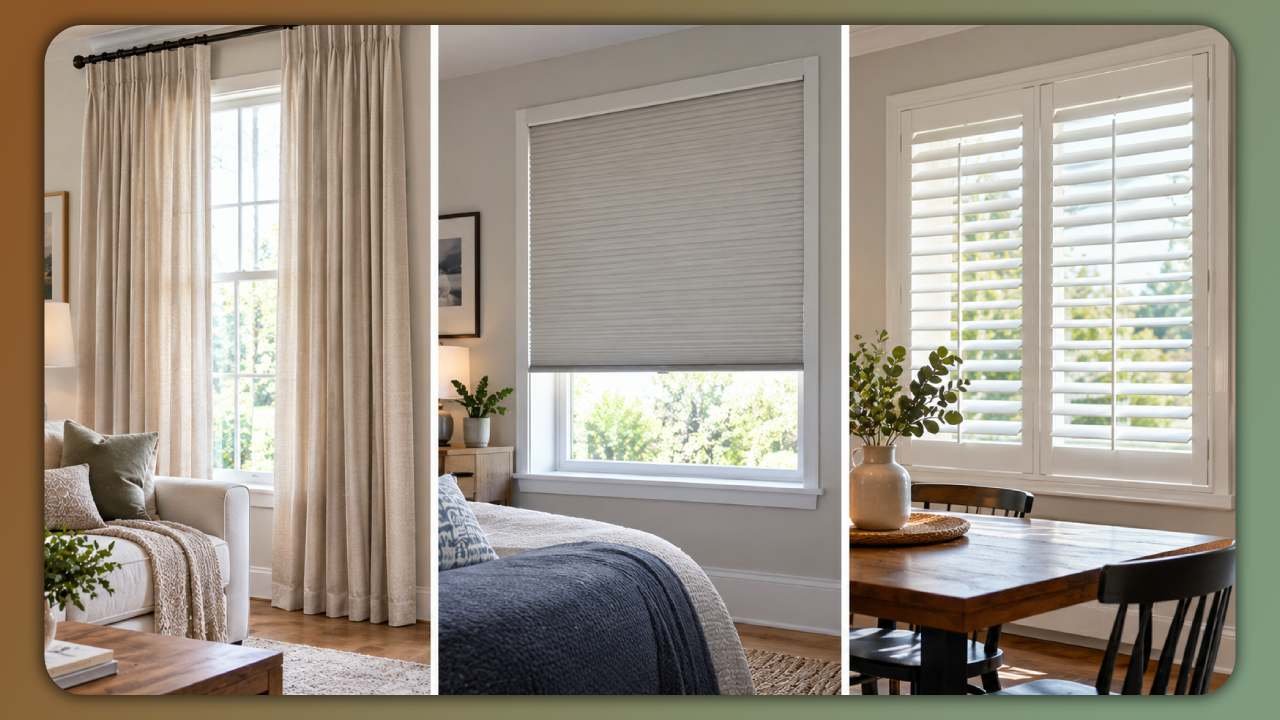
Curtains vs Blinds vs Shutters: Window Treatment Guide 2026
Curtains vs Blinds vs Shutters window treatment choices depend on your room, light, privacy, maintenance, and budget. Choose blinds for precise light control, curtains for softness and insulation, or shutters for durability and fixed architectural style. You can also combine 2 treatments when one layer cannot meet every daily need.
The strongest choice changes by room rather than across the whole home. A bedroom often needs blackout control, a kitchen needs easy cleaning, and a living room often needs softness. A home office needs glare control for screens. A bathroom needs moisture-resistant materials. Your window size, frame depth, opening style, and daily routine also affect the final choice.
Curtains vs Blinds vs Shutters Window Treatment: Which Works Best?
Curtains, blinds, and shutters use different structures, so each option handles light, privacy, cleaning, and durability differently. Blinds use tilting slats or vanes. Curtains use hanging fabric panels. Shutters use framed louvres fixed to the window.
Which option gives the most precise light control?
Blinds and shutters provide the most precise directional control because you can tilt individual slats or louvres. Venetian blinds, faux wood blinds, and plantation shutters let you redirect daylight while keeping the covering closed.
Curtains provide broader control through opening, closing, fabric opacity, and lining. Sheer curtains filter daylight, while blackout curtains block much more light. A lined curtain cannot redirect sunlight through a closed panel like a tilted blind.
Which option gives the softest room finish?
Curtains create the softest finish because fabric adds colour, texture, folds, and visual height. Linen curtains, cotton curtains, and velvet curtains each create different levels of warmth and formality.
Blinds create cleaner lines around the window. Roller blinds and Venetian blinds suit modern interiors with compact profiles. Shutters create a structured finish that suits traditional, coastal, and contemporary rooms.
Which option needs the least daily maintenance?
Shutters and simple blinds need less routine care than most fabric curtains. You can dust Venetian blinds or wipe faux wood blinds with a suitable cloth. You can wipe many composite shutters without removing the window covering.
Curtains need periodic washing or professional cleaning, depending on fabric and lining. Heavy velvet curtains and lined drapes also collect dust. Follow the fabric care label before washing any curtain panel.
Are Blinds the Right Window Treatment for Your Room?
Blinds suit rooms that need precise light control, compact coverage, and simple maintenance. Roller blinds, Venetian blinds, vertical blinds, faux wood blinds, and cellular blinds serve different needs.
Why do blinds work well in kitchens and bathrooms?
Blinds work well in kitchens and bathrooms because many hard materials handle moisture better than fabric. Faux wood, aluminium, and suitable PVC blinds resist everyday splashes and wipe clean.
Why do blinds suit home offices?
Blinds suit home offices because you can control glare without fully covering the window. Venetian slats let you redirect daylight away from a monitor while keeping some outside light.
What blind types should you consider?
Roller blinds provide a clean surface and work well for bedrooms, offices, and living rooms. Blackout roller blinds reduce bedroom light, while solar roller blinds reduce glare while preserving an outside view.
Venetian blinds provide adjustable slats and suit kitchens, bathrooms, and offices. Faux wood blinds provide a wood appearance with stronger moisture resistance than natural wood.
Vertical blinds suit wide windows and sliding doors because vertical vanes move sideways. Cellular blinds use honeycomb cells that trap air and improve insulation around the glass.
Are Curtains the Right Window Treatment for Your Room?
Curtains suit rooms where you want softness, colour, sound absorption, and flexible styling. Curtain panels also work well over blinds when you need both functional control and decorative warmth.
Why do curtains work well in bedrooms?
Curtains work well in bedrooms because lined fabrics can reduce incoming light and drafts. Blackout curtains provide stronger darkness than standard sheer curtains. Thermal-lined curtains also add another fabric layer between the room and the window.
Mount the curtain rod above the frame and extend the rod beyond both sides. A rod positioned 4 to 6 inches (10 to 15 cm) above the frame can create more visual height.
Choose floor-length panels when furniture and radiators allow the fabric to hang safely. Keep fabric at least 2 inches (5 cm) clear of a radiator to avoid blocking heat.
Why do curtains suit living rooms?
Curtains suit living rooms because fabric adds colour, texture, and acoustic absorption. Linen curtains create a relaxed finish, while velvet curtains create a heavier formal finish.
Choose curtain fullness based on the finished width of the window. A common target uses 1.5 to 2 times the finished track width. A 6-foot (1.8 m) track needs 9 to 12 feet (2.7 to 3.7 m) of fabric.
Are Shutters the Right Window Treatment for Your Room?
Shutters suit homeowners who want durable, fixed window coverage with adjustable louvres. Plantation shutters, full-height shutters, café shutters, and composite shutters cover different window layouts.
Why do shutters suit bathrooms and kitchens?
Shutters suit bathrooms and kitchens when you select moisture-resistant materials. Composite and suitable PVC shutters resist humidity better than untreated fabric.
Why do shutters suit long-term homes?
Shutters suit long-term homes because fixed panels can last for many years with routine cleaning. Wood, composite, and other engineered materials offer different durability and moisture characteristics.
Choose shutters when you expect to keep the same window treatment for a long period. Avoid fixed shutters when you rent or expect frequent moves because removal requires more work.
Which Window Treatment Works Best in Each Room?
The right window treatment changes with the room’s main job. Match the covering to light, moisture, privacy, cleaning, and available wall space before choosing colour or pattern.
Which treatment works best for bedrooms?
Choose blackout curtains, blackout roller blinds, or a layered blind-and-curtain setup for bedrooms. Blackout fabric helps control early morning light, while blinds provide compact coverage near the glass.
Use a cellular blind when insulation matters most. Use thermal curtains when you also want fabric texture and sound absorption. Combine both when you need strong darkness and a softer finish.
Which treatment works best for kitchens and bathrooms?
Choose faux wood blinds, aluminium blinds, or moisture-resistant shutters for kitchens and bathrooms. Hard surfaces wipe clean and handle routine humidity better than delicate fabric.
Keep curtains away from sinks, hobs, baths, and showers. Choose a washable café curtain only when the fabric stays outside direct splash areas.
Which treatment works best for living rooms and dining rooms?
Choose curtains for rooms where softness and colour matter most. Choose shutters for a structured architectural finish. Choose blinds for compact coverage and directional daylight control.
Layer a roller blind with curtains when the room needs both glare control and decorative softness. Use sheer curtains during daylight and a lined layer for evening privacy.
Which treatment works best for home offices?
Choose Venetian blinds, roller blinds, or shutters for home offices because each option controls glare near a screen. Use a solar roller blind when you want daylight and an outside view.
Place the desk so direct sunlight does not strike the screen. Adjust the covering during peak glare periods rather than keeping the window fully closed.
How Should You Compare Privacy, Insulation, and Durability?
To compare privacy, insulation, and durability, score each treatment against the actual problem in your room. A window facing a busy street needs different coverage from a shaded rear bedroom.
Blinds offer strong privacy when you tilt slats correctly. Blackout roller blinds offer stronger darkness than standard Venetian blinds. Curtains offer strong privacy when the fabric fully covers the window and the lining blocks silhouettes.
Cellular blinds provide strong insulation because honeycomb cells trap air. Thermal-lined curtains add insulation through fabric layers. Shutters provide some insulation through solid panels and close-fitting frames.
Heavy curtains also absorb more sound than hard coverings. Choose lined curtains for a bedroom facing traffic or a busy road. Do not treat any window covering as a substitute for proper glazing or window sealing.
Durability depends on material, hardware, usage, moisture, and installation. Shutters generally suit long service periods. Quality blinds can also last for years when you clean mechanisms and avoid excessive force. Curtains need fabric care and can show fading near strong sunlight.
How Much Do Curtains, Blinds, and Shutters Cost?
To compare window treatment costs, separate the product price from measuring, fitting, hardware, motorisation, and custom sizing. Prices vary by material, window size, fabric, finish, and supplier.
Blinds often provide the lowest entry cost among the 3 options. Ready-made curtains can also cost less than custom curtains, while premium fabrics and made-to-measure tracks raise the total. Shutters usually require a higher initial budget because manufacturers build frames and panels for each opening.
How to Measure a Window for Curtains or Blinds
To measure a window for curtains or blinds, record the width and drop at 3 points. Measure the top, middle, and bottom width, then record the smallest width when the fitting requires a recess measurement.
Measure the height at the left, centre, and right. Record the smallest height for a recess fit. Record the largest suitable height when the treatment sits outside the recess.
For curtains, measure the track or pole width rather than only the glass width. Add the required overlap beyond the window based on the track system. Check the supplier’s measuring guide before ordering made-to-measure products.
For blinds, record the recess depth and handle position. Check whether the window opens inward and whether the blind needs extra clearance. Measure windows wider than 6 feet (1.8 m) carefully because product limits can affect the design.
How to Plan Window Treatment Installation
To plan window treatment installation, choose the fitting method before buying the product. Decide between recess fit, exact fit, face fit, ceiling fit, or wall-mounted curtain hardware.
Use a suitable drill, wall plugs, screws, tape measure, pencil, and spirit level for many curtain installations. Ask a qualified installer to assess masonry, plasterboard, unusual frames, or heavy shutter assemblies.
Quick-reference table:
| Task | Typical timing | Method | Difficulty |
| Measure a standard window | 15 minutes | Record 3 width and 3 height points | Easy |
| Compare 3 treatment samples | 30 minutes | Test light, privacy, and texture | Easy |
| Fit a curtain pole | 45 to 60 minutes | Drill, plug, screw, and level | Moderate |
| Fit a standard roller blind | 30 to 60 minutes | Brackets, screws, and level | Moderate |
| Fit plantation shutters | 2 to 4 hours | Frame, panel, hinge, and level | Advanced |
| Test daylight performance | 1 day | Check morning, noon, and evening | Easy |
Curtains vs Blinds vs Shutters Window Treatment: How Should You Choose?
To choose curtains vs blinds vs shutters window treatment performance, start with the room’s main need. Write down the top 3 requirements before comparing products.
Choose blinds when you need compact coverage, adjustable light, easy cleaning, or a lower starting budget. Choose curtains when you need softness, fabric colour, sound absorption, or flexible styling. Choose shutters when you need long-term durability, fixed coverage, and an architectural appearance.
Check the window shape before selecting the treatment. Standard rectangular windows support the widest range of products. Bay windows, arched windows, skylights, corner windows, and sliding doors need specialist fitting decisions.
Check the room’s moisture level before selecting fabric. Kitchens and bathrooms need materials that tolerate humidity and cleaning. Bedrooms and living rooms allow more fabric choices because moisture exposure stays lower.
Check the home’s design before selecting the finish. Contemporary interiors often suit slim roller blinds, simple curtains, and clean-lined shutters. Traditional interiors often suit fuller curtains, Roman shades, and painted shutters.
SpaceKeep’s guide to window treatment ideas covers room-specific combinations, materials, and 2026 styles. Use the guide after you identify the functional requirements for each window.
How to Combine Blinds and Curtains
To combine blinds and curtains, place the functional layer closest to the glass. Place the fabric layer farther into the room.
Use sheer curtains when you want daylight with a softer view. Use blackout curtains when the bedroom needs stronger darkness. Use decorative curtain panels when the blind already provides the required privacy and light control.
Keep both layers clear of handles and opening paths. Allow enough side space for curtains to stack without covering too much glass. Check the combined depth before installing brackets.
Which Window Treatment Fits a Modern 2026 Interior?
Modern 2026 interiors often use simple profiles, natural textures, warm neutrals, and layered window coverings. Your room should still drive the functional choice before you follow a colour or style trend.
Contemporary interiors often suit slim roller blinds, neutral curtains, and plantation shutters with clean louvre lines. Natural linen, cotton blends, faux wood, and warm timber tones add texture without excessive pattern.
SpaceKeep’s guide to contemporary interior design explains how clean lines, neutral colours, and mixed materials shape current rooms. Use those principles to coordinate window coverings with furniture, flooring, and lighting.
Frequently Asked Questions
Are blinds cheaper than shutters?
Yes. Blinds usually have a lower starting price than custom shutters. Material, size, motorisation, and installation can raise the price of either option.
Do curtains provide better insulation than blinds?
Not always. Cellular blinds provide strong insulation through trapped air, while thermal-lined curtains add insulation through dense fabric and lining.
Can you use curtains and blinds together?
Yes. Blinds can control daily light and privacy, while curtains add softness, sound absorption, and extra darkness.
Are shutters suitable for bathrooms?
Yes. Moisture-resistant composite or suitable PVC shutters suit bathrooms because hard surfaces resist humidity and support wipe-clean maintenance.
How long should window treatments last?
Service life depends on material, hardware, use, moisture, and care. Quality shutters often serve longer than fabric curtains. Quality blinds can also provide many years of service.
Conclusion
Curtains vs blinds vs shutters window treatment decisions work best when you match each window to its daily job. Choose blinds for precise control, curtains for softness and insulation, or shutters for durable architectural coverage. Layer 2 options when one treatment cannot meet every requirement. For more room-specific ideas, visit SpaceKeep’s home decor ideas and plan each window around light, privacy, maintenance, and style.